Personalized Education in Physics
Learn computational physics through Socratic questioning, code simulations, and mastery-based progression.
The Workflow
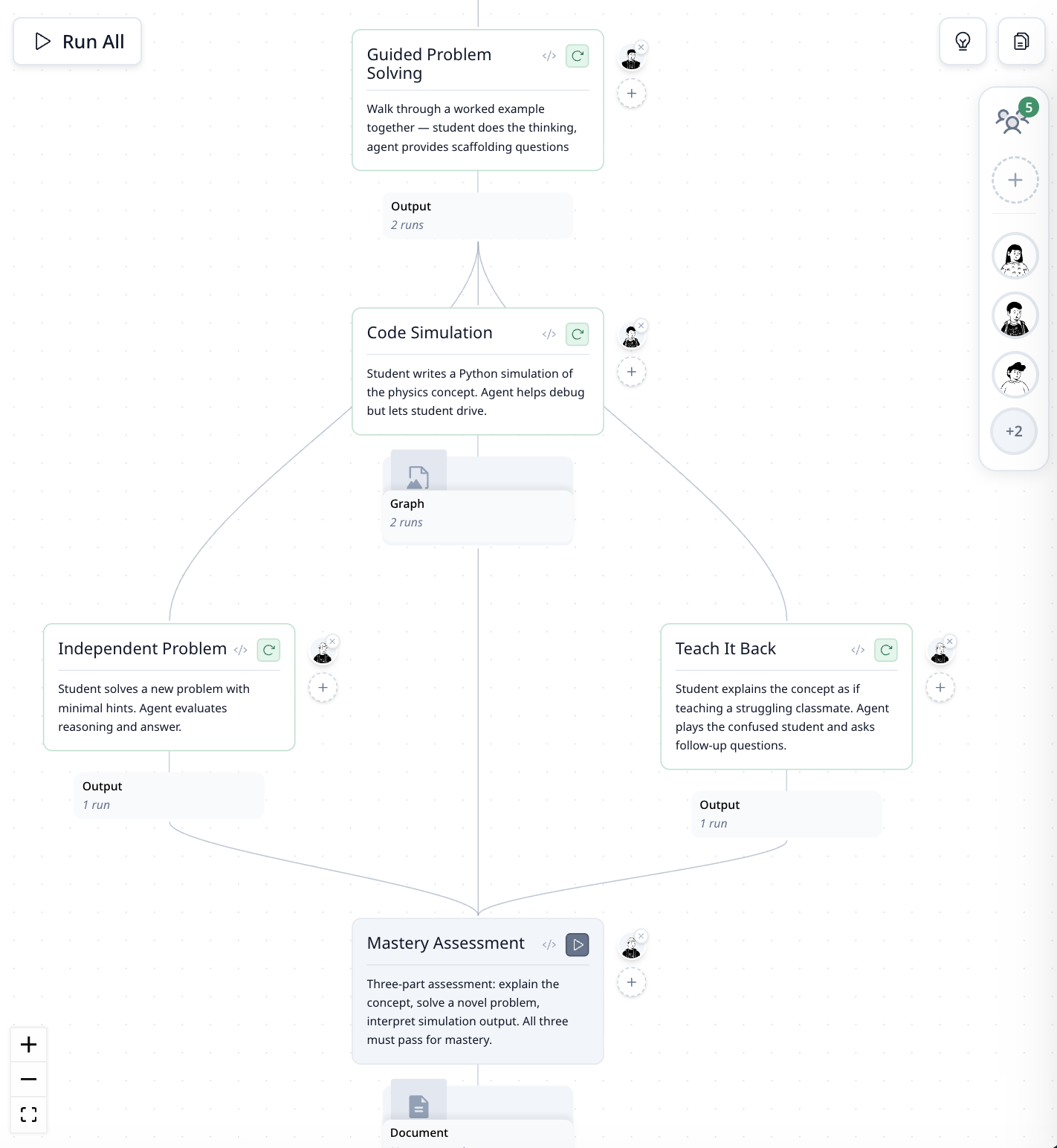
| Step | What It Does |
|---|---|
| Guided Problem Solving | Walk through a worked example together — the student does the thinking, the agent asks scaffolding questions |
| Code Simulation | Student writes a Python simulation of the concept — the agent helps debug but lets the student drive |
| Independent Problem | Student solves a new problem with minimal hints — the agent evaluates reasoning |
| Teach It Back | Student explains the concept as if teaching a struggling classmate — the agent plays the confused student |
| Mastery Assessment | Three-part test: explain the concept, solve a novel problem, interpret simulation output — all three must pass |
How It Was Built
"Build a Socratic physics tutor. It should never give direct answers — only guide through questions. Include Python simulations and track mastery."
MorphMind designed a 5-step learning loop where each step tests a different dimension of understanding: guided practice, coding, independent solving, teaching, and formal assessment.
Why This Works Better Than a Chatbot
Ask ChatGPT to "teach me physics" and it gives you the answer. Immediately. That's the problem:
- It tells you instead of teaching you — you ask "what happens when I throw a ball up?" and get a perfect textbook paragraph. You read it, nod, move on. But you didn't actually reason through it. The moment the question is rephrased on an exam, you're stuck.
- There's no progression — whether you understood the last concept or not, the chatbot moves on. It has no idea if you actually grasped Newton's second law before jumping to energy conservation. There's no mastery gate.
- Code simulations are copy-paste — the chatbot writes the simulation for you. You run it, see a plot, learn nothing about the physics or the code. Here, the student writes the code. The agent helps debug, but the student drives.
| The Problem | Workflow Approach |
|---|---|
| Gives the answer immediately | Socratic questioning — student reasons first |
| No check before moving on | Mastery assessment gates progression |
| Writes the code for you | Student codes, agent scaffolds |
| Passive reading | Teach-it-back step forces active recall |
Example Prompts
Start from Topic 1: Kinematics. I'm a first-year physics student.
I'm confused about conservation of energy — walk me through a problem.
Here's my Python simulation of projectile motion. Can you review it?
Upload my syllabus — align your teaching to my course schedule.
Frequently Asked Questions
Can AI teach physics through Socratic method?
This agent never gives direct answers. It asks probing questions, lets the student reason through the problem, and provides hints only when stuck. The workflow includes guided practice, code simulations, and a teach-back step where the student explains the concept.
How does AI-powered mastery-based learning work?
Each topic requires passing a three-part assessment: conceptual explanation, novel problem solving, and simulation interpretation. The student cannot advance until all three are satisfied. Problem difficulty adapts to the student's performance.
Can AI help with computational physics homework?
The agent helps students write and debug Python physics simulations — but it doesn't write the code for them. The student drives the implementation while the agent asks debugging questions and checks physical plausibility of the results.